Today’s 21st century learning example originally appeared in the curriculum blog Teaching and Learning in HSE. It is reprinted here as a fun example example of what it can mean to up-end a traditional, rote activity – turning it into something creative and personally meaningful for each student. Think: student choice, student VOICE, and student-driven learning and expression. Enjoy!
The Importance of Play
by Angela Fritz, Art Department Chair, Hamilton Southeastern High School
When I was in grade school, the excitement of the holidays seemed to build in a palpable way as an impending vacation grew closer. In an era that had a different sense of urgency, almost without fail, the day before vacation would be filled with a variety of treats and games. Word searches and crossword puzzles, of questionable educational value but perhaps mildly attached to either our curriculum or the holiday itself, were the norm.
 My bet is you know what I’m talking about: Lay your hand down on the paper and trace around it. The fingers become some semblance of feathers and your thumb make a neck. As for the legs, they just had to be added. Everybody’s hand turkey came out about the same—a lot like the teacher’s example.
As an art teacher, I can appreciate the patience involved in the cutting and staying inside the lines. I even see value in those practiced skills. There is no question, however, that the traditional assignment lacks personal voice and relevance. So over time, we stopped making hand turkeys.
Somewhere along the way that we moved beyond the cookie cutter crafts because they have little educational value. For the most part, it was a time filler and not very personal, not very unique, not very relevant. As educators, we were likely correct about that incarnation of the hand turkey assignment.
By dropping the craft project, did we also lose some of the fun, some of the excitement? Perhaps. But what if we reinvented those mundane childhood “arts and crafts” projects and turned them into something fun and exciting but still with educational value? Can we have it all? Can learning be fun?
My Experiment
As a teacher, I am still filled with excitement as a holiday closes in on us, for obvious reasons: time off with friends and family, time to relax and get rejuvenated. Maybe it’s just romanticized memory, but I often have that feeling of being a little kid in school, excited about the possibility of “fun and games” the breaks bring to the school setting.
Feeling nostalgic for this pre-vacation excitement, I decided to collaborate with Dan Moosbrugger, a fellow art teacher. We decided to try for it all! A few days before Thanksgiving, we threw down the gauntlet to our AP Drawing and Three-Dimensional Art students. We challenged them to show us their skills and tackle the hand turkey. Their task was to take what is a stereotypical and mundane assignment and produce something unique, something exceptional, something far from ordinary.
Our students were immediately intrigued, and the results were beyond our expectations. They took the challenge to heart and really outdid themselves. Their results are not only interesting, they are funny, extravagant, and full of personal voice and artistic expression.
A Rafter of Turkeys
Enjoy this gallery walk through a gobble of turkeys produced by our students. (How many of you knew that the designation for a group of turkeys is a rafter or gobble of turkeys?)
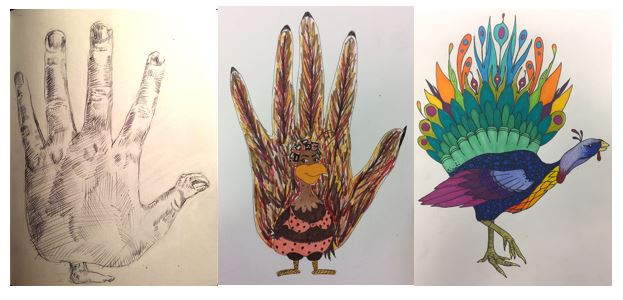
Student 1 took a literal approach to creating a hand turkey. Student 2 tied her hand turkey to other work she is doing on feminism. Student 3 dabbled with aesthetics. All of these artists are seniors.

Student 4’s “Rubber Glove” turkey took a different approach by adding wax to Rubbermaid cleaning gloves. Student 5 used mixed metals, and Student 6 went for a humorous commentary on the life of a turkey.
You have to admit these are NOT our grade school hand turkeys.
Add Play, but with a Purpose
Dr. Stuart Brown, founder of the National Institute of Play says that, “Play energizes us and enlivens us. It eases our burdens. It renews our natural sense of optimism and opens us up to new possibilities.” My students weren’t following a teacher example. They were seeing how far out of the water they could blow the traditional examples. They were having fun, but they were making their work personal. The results reflect the imagination of the students and skills we hope they developed, and they were certainly engaged in the challenge!
My point is that the value of play should not be underestimated. There can be real value in the lighthearted play we may have long ago dismissed. Play with a purpose belongs in school! I have learned a lesson from this assignment. With a little creativity and imagination, we can have both learning and play. In fact, with creativity and imagination, the fun is in the learning.
Perhaps we should reconsider and reinvent more than just the “hand turkey.”
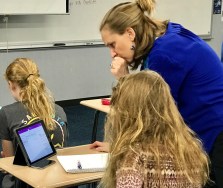 At first glance, nothing looked “messy” in Señora Eisinger’s junior high Spanish class. I had arrived to help students connect their Canvas (Learning Management System) accounts with Office365, in particular, to a OneNote Class Notebook through which Señora and her students would connect digitally and collaborate over the coming year. When I entered, students were seated and still, reviewing the day’s objectives. All was peaceful. All was traditional and comfortable. All was quiet.
 Digital connection and collaboration, though, don’t lend themselves to quiet, traditional practice – and they are rarely peaceful to set up! There’s the matter of accounts – Are you logged into Canvas? Good. Now log into OneDrive on your iPad. Oops – No, that must be your personal account – you need to find your school account. What? You don’t see your Canvas course for Spanish class? Okay. Click here. Your page won’t load? Forget the wifi and sign in again.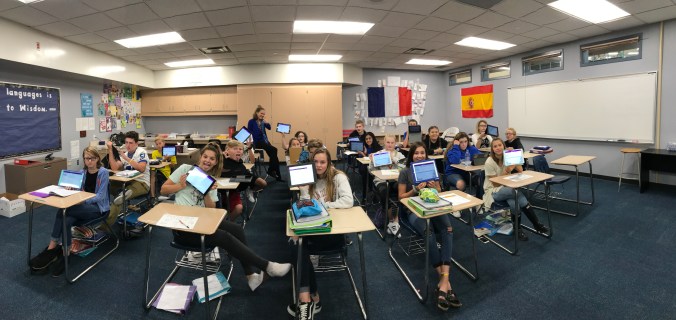


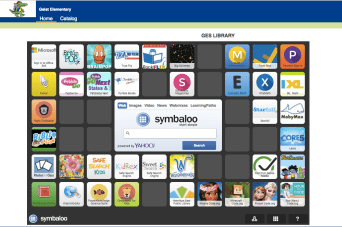
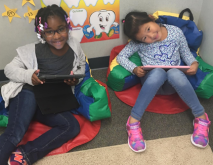 On top of the powerful web filters that HSE Schools has in place to protect our students, our schools use many additional strategies to streamline web access in order to keep our students safe. Thanks to Geist Elementary School for sharing these tips!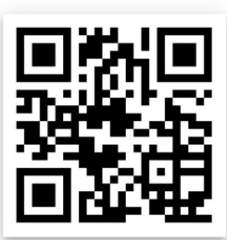
 Welcome back, HSE21 Shorts readers! We begin the new school year with a timely real world connection. A member of our community, Dr. Jerome Adams, was recently confirmed as the new Surgeon General of the United States! Before Dr. Adams is sworn in next week in Washington, D.C., he graciously took time to interact with students at Geist Elementary and HSE High Schools.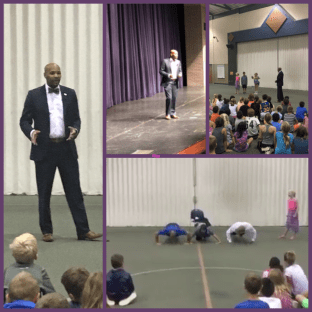
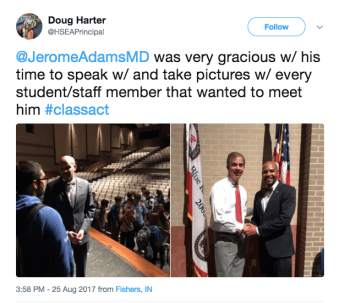 HSE21 Shorts asked teachers to describe Dr. Adams’ impact. Here are responses from Biomedical Innovations teacher Ashly Heckly:
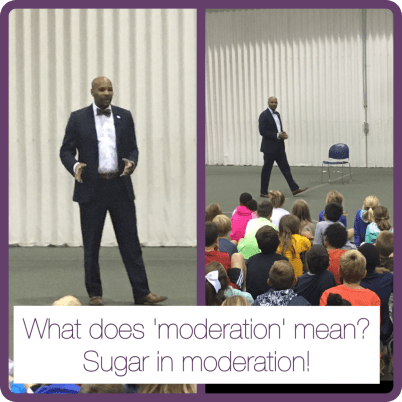 The students also admired Dr. Adams’ outstanding character traits. They were so grateful that he stayed to talk and take a picture with each student that waited in line. They were also amazed at how humble he is even though he has many great achievements.
 Cramming for finals. Memorizing hundreds of useless (now Google-able) facts that were promptly forgotten. Most all of us can recount at least one nightmarish exam saga in our high school or college past!
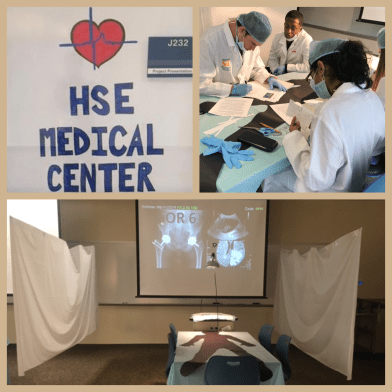
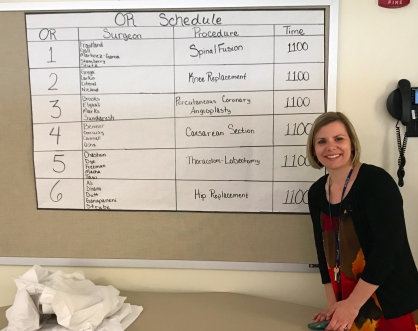 Biomedical Innovations is designed for students to work through open-ended problems focused on health challenges of the 21st century. After having students work in groups throughout the year, an independent paper and pencil type of final did not feel right. Instead, I decided to transform the presentation lab into six operating rooms where students would work through the final as a group. The final was composed of six “surgeries” based on problems we studied throughout the year. The students recorded their answers to each problem on the paper body. To complete the experience, students dressed in their lab coats and received hospital ID badges, scrub hats, masks, booties, and gloves.


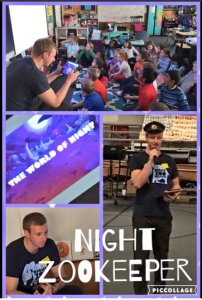 Wow! What energy your recent visit brought to HSE Schools! We are so thankful that you were able to stay in Indiana for eight school days – inspiring teachers and young zookeepers to imagine, wonder and create via the written word.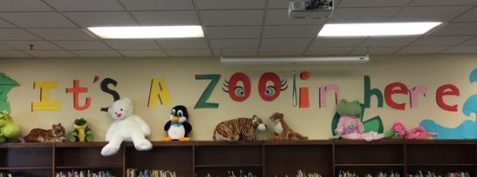
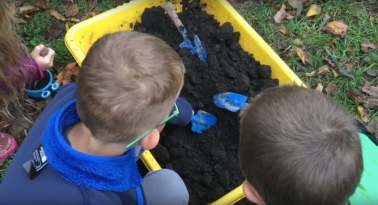 Personal digital tools have opened up a plethora of creative possibilities for HSE’s youngest learners this year. Among them is the ability to document discoveries on class study trips (aka, field trips). Instead of just telling mom or granddad what we learned at the farm, we can now take photos, record audio, and research our wonderings on the spot – then share everything we learned with friends and relatives! And yet…for six-year-olds, some study trips just don’t lend easily themselves to carrying iPads around all day. What’s a 21st-century educator to do?
 HSE21 Shorts