The Diversity Committee at Hamilton Southeastern Intermediate & Junior High recently led their entire community (teachers & students in grades 5-8) through a common book study that became a powerful perspective-taking experience for all. A big thanks to Media Specialist JoyAnn Boudreau for sharing their story!
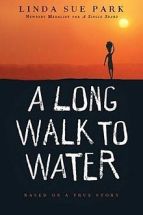 A Long Walk to Water by Linda Sue Park, a Global Read Aloud selection for 2017, was chosen for our book study. It was the perfect fit for our students, as it is accessible to all four of our 5-8 grade levels. A Long Walk to Water would provide a forum through which to address our Diversity Committee goals of global thinking/awareness and empathy-building. The book also lended itself to other HSE21 learning goals such as collaboration and inquiry.
We wanted the whole school to be on board! Our Diversity team leader worked persistently to figure out a way to make this work! Global Read Aloud officially kicked off October 2. When students came to the library, they got the chance to collaborate and work with others around the globe, activities encouraged by the Global Read Aloud. Students participated in global Flipgrid boards, Twitter chats, and global Padlet boards. They asked and answered questions of other students from around the world and shared information. They took virtual reality field trips to refugee homes and camps. They used water calculators to see how much water they were using and considered how they might use less!
Though the ‘official’ Global Read Aloud wrapped up on November 10th, HIJH’s journey isn’t nearly over. We’re still developing next steps, exploring options for a water walk and for a fundraiser to help build a water well in Africa. Students are passionate; they want to help and make a difference. A few students have already begun bracelet sales to raise funds to go towards a water well. They told us, “This book raised our global awareness, and now we’re trying to raise money for a well.”
By reading in community — a few chapters each week from the right book — and with teacher support, students’ eyes are a little more open to the world around them than they were before.
Here are a few other favorite quotes from student responses:
- “It’s fun to have the whole school reading the same book and everyone in the same chapters.”
- “I have enjoyed so far in the book that all the characters have something different about them.”
- “People take many things for granted, but we take our everyday needs for granted the most.”
- “Do you have any books like A Long Walk to Water in the library?”
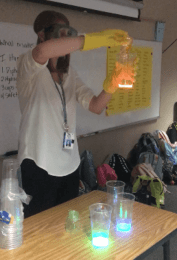 Have you ever wondered what makes a glow stick glow? Erica Erickson’s 4th graders used that question as a springboard for an investigative process practicing the scientific method. First, students hypothesized and gathered materials. Following an intriguing demonstration by Mrs. Erickson, students wrote the steps to the procedure, formed observations, and drew conclusions. Through the experiment, students discovered that glow sticks have two chemicals. In the large plastic tube is the diphenyl oxalate. The plastic tube also contains a smaller glass tube which holds hydrogen peroixide and chemiluminescent dye. When a glow stick is cracked, the shattering of the glass tube allows the chemicals to combine and form a reaction. Now that’s a GLOWING experiment! #buddingscientists


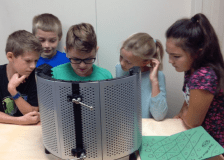
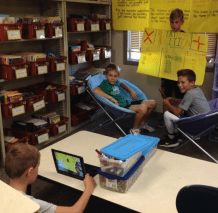


 Students are our future leaders, and what better way to show them that by offering them chances to BE leaders now. This year my eighth graders were challenged to write an “About Me” paragraph — something that, by eighth grade, they have done several times. The difference? This paragraph could not include their name. In these “About Me” paragraphs, the eighth graders’ aim was showcase their best qualities in an effort to appeal to a 5th/6th grade audience. Without knowing names, the younger students read and selected buddies based solely on the power of the 8th graders’ writing.
  After connecting with their buddies in the library, students were asked to discuss what they like to read and select a book that would inspire all members of the partnership. Students set reading goals, exchanged e-mail communication, and discussed characterization and plot development as they worked their way through the novel. Eighth graders walked in to every meeting with a plan, and they were met with thoughtful and engaging questions from their buddies.


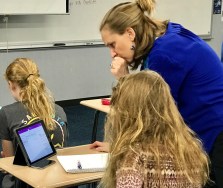 At first glance, nothing looked “messy” in Señora Eisinger’s junior high Spanish class. I had arrived to help students connect their Canvas (Learning Management System) accounts with Office365, in particular, to a OneNote Class Notebook through which Señora and her students would connect digitally and collaborate over the coming year. When I entered, students were seated and still, reviewing the day’s objectives. All was peaceful. All was traditional and comfortable. All was quiet.
 Digital connection and collaboration, though, don’t lend themselves to quiet, traditional practice – and they are rarely peaceful to set up! There’s the matter of accounts – Are you logged into Canvas? Good. Now log into OneDrive on your iPad. Oops – No, that must be your personal account – you need to find your school account. What? You don’t see your Canvas course for Spanish class? Okay. Click here. Your page won’t load? Forget the wifi and sign in again.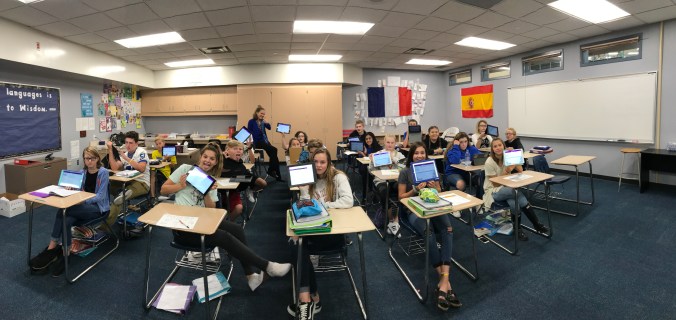


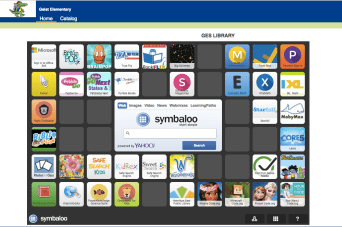
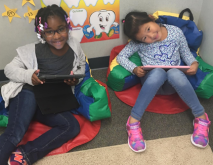 On top of the powerful web filters that HSE Schools has in place to protect our students, our schools use many additional strategies to streamline web access in order to keep our students safe. Thanks to Geist Elementary School for sharing these tips!
 Welcome back, HSE21 Shorts readers! We begin the new school year with a timely real world connection. A member of our community, Dr. Jerome Adams, was recently confirmed as the new Surgeon General of the United States! Before Dr. Adams is sworn in next week in Washington, D.C., he graciously took time to interact with students at Geist Elementary and HSE High Schools.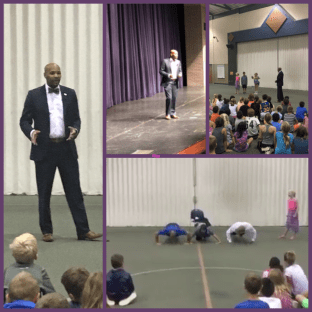
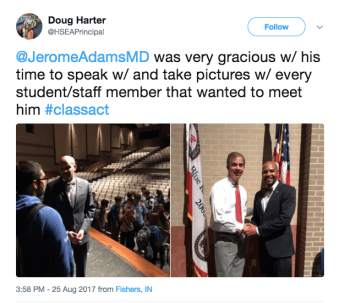 HSE21 Shorts asked teachers to describe Dr. Adams’ impact. Here are responses from Biomedical Innovations teacher Ashly Heckly:
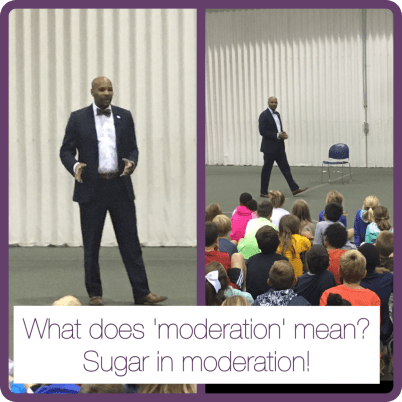 The students also admired Dr. Adams’ outstanding character traits. They were so grateful that he stayed to talk and take a picture with each student that waited in line. They were also amazed at how humble he is even though he has many great achievements.
 Cramming for finals. Memorizing hundreds of useless (now Google-able) facts that were promptly forgotten. Most all of us can recount at least one nightmarish exam saga in our high school or college past!
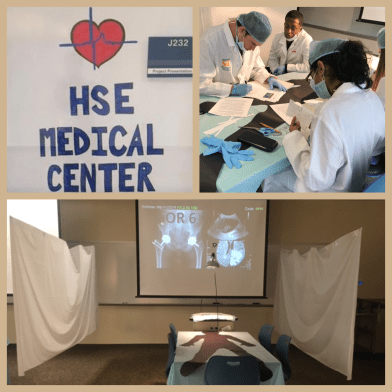
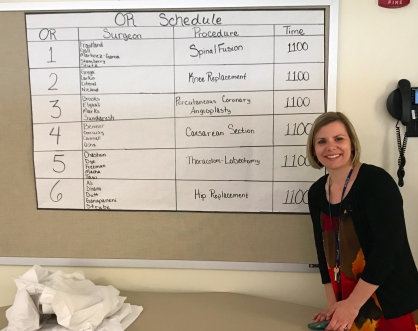 Biomedical Innovations is designed for students to work through open-ended problems focused on health challenges of the 21st century. After having students work in groups throughout the year, an independent paper and pencil type of final did not feel right. Instead, I decided to transform the presentation lab into six operating rooms where students would work through the final as a group. The final was composed of six “surgeries” based on problems we studied throughout the year. The students recorded their answers to each problem on the paper body. To complete the experience, students dressed in their lab coats and received hospital ID badges, scrub hats, masks, booties, and gloves.
 HSE21 Shorts