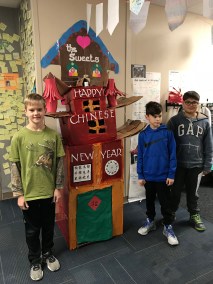
 This two-part story is a wonderful example of how great teachers foster deep and meaningful learning. As you read about the Celebration Houses project, notice how Indiana’s Academic Standards are addressed in ways that are inquiry-based, engaging, and authentic. Notice how student teams collaborate towards a final creative product. One more…Notice how technology was employed purposefully as a cognitive learning tool!
HSE21 Shorts asked fifth grade teachers Amber Hudson and Lisa Keaffaber, from Hamilton Southeastern Intermediate & Junior High, to take us into their ‘teacher brains’ to explain how this learning experience connected content from across the curriculum. In our next post, we’ll examine ways in which this project fostered community connections both within the classroom and throughout our city.
Q: How did this project come about?
A: It all started when Amber said, “Hey, I heard about this gingerbread house idea, and I think we should try it.” After brainstorming some ideas on how to incorporate it into our curriculum, standards, and our students’ interests, the Gingerbread Celebration House Project was born.
Students returned from Thanksgiving break to find the classrooms transformed. In place of desks were heaps of cardboard and cardboard boxes. Hanging around the rooms were 31 QR codes with pictures, and huge sheets of paper with thought-provoking questions.
Before students could experience the room, we read two picture books: one on being an American and one on faith. Both books focused on the beautiful differences that are among us and seen in our celebrations of faith. After experiencing the songs, dances, videos, and pictures of the various holidays via the QR codes and pictures, each student uploaded a video to FlipGrid explaining which celebrations they found most interesting. This is how we determined which student would construct which house.
 Q: What were your goals for the project?
A: Our goals were to give students an awareness and appreciation of cultural celebrations from around the world that occur throughout the year AND to have them share their understanding with the people of Fishers.
Though many families in our district do celebrate Christmas, other important holidays are celebrated by families in our classroom and around the world that are also significant and special.
Q: How did the learning experience align with academic standards?
In humanities class, social studies is incorporated into reading and writing. Through reading, students discovered both similarities and differences they had with other students’ traditions. For example, light (as in candles and strands of lights) are a common feature in holidays for Buddhists, Christians, Jews, and Muslims.
Here is a sample of Indiana Academic Standards for humanities subjects that were addressed in this project:
Reading standards:
- Determine two or more main ideas of a text.
- Explain the relationships or interactions between two or more events, ideas, or concepts based on specific information in the text.
- Combine information from several texts or digital sources on the same topic in order to demonstrate knowledge about the subject.
- Determine the meaning of general academic and content-specific words and phrases in a nonfiction text relevant to a fifth grade topic or text.
Writing standards:
- Introduce a topic; organize sentences and paragraphs logically, using an organizational form that suits the topic.
- Employ sufficient examples, facts, quotations, or other information from various sources and texts to give clear support for topics.
- Connect ideas within and across categories using transition words (e.g., therefore, in addition).
- Include text features (e.g., formatting, pictures, graphics) and multimedia when useful to aid comprehension.
In STEM (Science-Technology-Engineering-Math) class, math and science are interwoven for a more real world experience. Constructing and decorating the Celebration Houses became an authentic means through which students could practice STEM skills. Students used the engineering design process to develop a viable structure for their house; they then applied their skills to construct and decorate their houses. Hands on. The engagement was through the roof — literally!
Math standards:
- Multiply multi-digit whole numbers fluently using a standard algorithmic approach.
- Add, subtract, multiply, and divide decimals to hundredths, using models or drawings and strategies based on place value or the properties of operations. Describe the strategy and explain the reasoning.
- Solve real-world problems involving multiplication and division of whole numbers and decimals
- Find the area of a rectangle with fractional side lengths by modeling with unit squares of the appropriate unit fraction side lengths, and show that the area is the same as would be found by multiplying the side lengths. Multiply fractional side lengths to find areas of rectangles, and represent fraction products as rectangular areas.
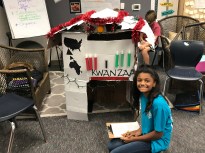
Enjoy the Celebration House photos below, and be on the lookout for Celebration Houses 2, as the Celebration Houses head out to the Fishers community!


 Welcome back, HSE21 Shorts readers! We begin the new school year with a timely real world connection. A member of our community, Dr. Jerome Adams, was recently confirmed as the new Surgeon General of the United States! Before Dr. Adams is sworn in next week in Washington, D.C., he graciously took time to interact with students at Geist Elementary and HSE High Schools.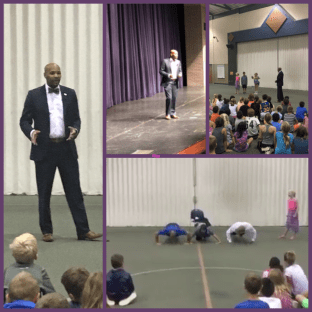
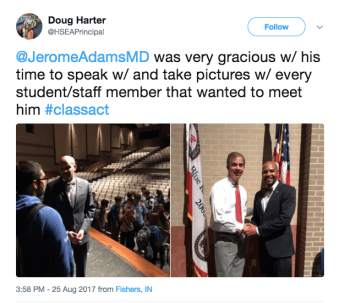 HSE21 Shorts asked teachers to describe Dr. Adams’ impact. Here are responses from Biomedical Innovations teacher Ashly Heckly:
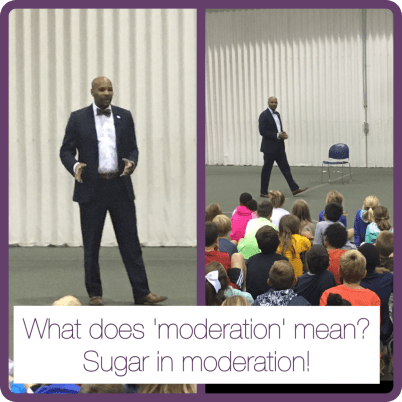 The students also admired Dr. Adams’ outstanding character traits. They were so grateful that he stayed to talk and take a picture with each student that waited in line. They were also amazed at how humble he is even though he has many great achievements.


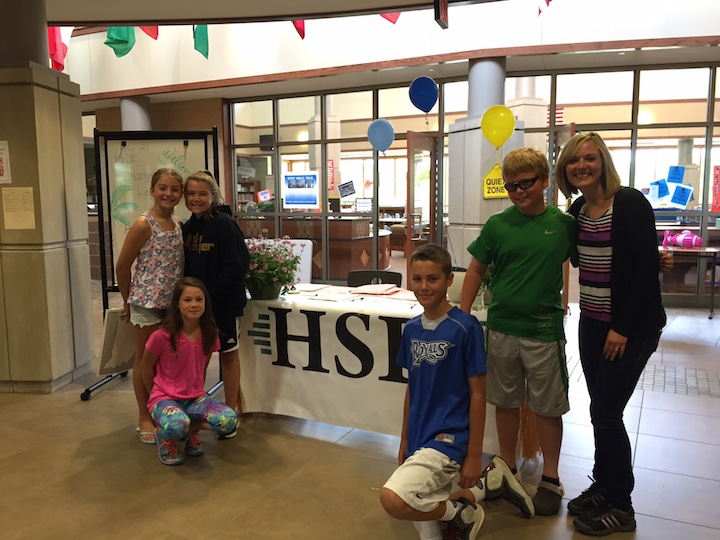
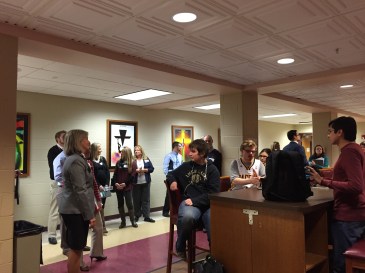 HSE’s August 2015 BYOD roll out is the culmination of several years of research, strategic planning, and practical preparation. For our school district, part of this preparation has included visiting other schools and districts throughout Indiana, especially those that have gone before us in this major curricular shift. The image here is of a recent visit to Brebeuf, a nearby high school already in its third year of a BYOD program. The group of HSE and Brebeuf teachers and educators spent half a day relating experiences, discussing concerns, and learning from one another. Just as collaboration among students deepens learning, so it is with teachers. Our teachers hope to continue the relationships that have begun with Brebeuf’s educators, and with today’s digital tools, continuing conversations are just a mouse click away.
 f Cumberland Road Elementary, has developed several online spaces through which he highlights student learning, shares lessons with parents, and gives students information to practice musical skills and pieces. Mr. Hussain keeps lessons up-to-date on Google Drive in grade level folders, accessible to parents and students 24-7. Through his YouTube channel within HSE’s domain, parents now have a window





 HSE21 Shorts