HSE’s Department Chairs, Principals and Assistant Principals at the secondary level are participating in three days with Schauna Findlay, a state and national expert on standards, curriculum, assessment, and instruction. The experience is reinforcing the realization that the Indiana College and Career Readiness Standards, or IN CCR, call on us to make a number of shifts as instructional leaders. Here are a few key points from day one:
· We need to use the words of the standards in our explanations to students so that they understand and apply the terminology.
· We need to fortify our identification of high quality texts in all subjects. We need to leverage text complexity variance to support appropriate options for student choice.
· We need to analyze our current assessment practices and retool where necessary to give students practice at complex problem solving.
· We need to value quality over quantity and trust that students will perform better on tests if they are accustomed to persevering through multi-layered challenges.
· In terms of academic matters, we need to encourage teachers to engage in creative approaches and risk taking beyond compliance.
· We need to leverage opportunities for interdisciplinary collaboration.
· We need to reinforce acceptance that good curriculum is iterative and responsive. We are never “done getting ready”.
· We need to assure that our assessments measure appropriate performance expectations so that we can address the sense of entitlement to “A’s”.
· We need all teachers to appreciate the importance of teaching literacy skills in the context of their respective subject areas.
Improving instructional practice is a continuous journey. Regardless of how the State defines the mark, we are in an excellent position to take advantage of our advantage.
Submitted by Dr. Dawn McGrath, Director of Secondary Curriculum
 Meet the designers of a new Android app–a Shrek-themed soundboard app, to be exact. These teens, students at Hamilton Southeastern High School, are creating the app as part of Programming I, HSE High School’s introductory computer programming course. Student duos have used MIT’s App Inventor software to design their apps, and are now in the testing phase. Along with the apps, students are building Google Sites with pages to showcase and share their creativity. By year’s end, each teen’s Google Site will have grown into a well-rounded digital portfolio of his/her computer programming experiences and products. Look out, Silicon Valley. The young innovators of Fishers, Indiana are off and running!
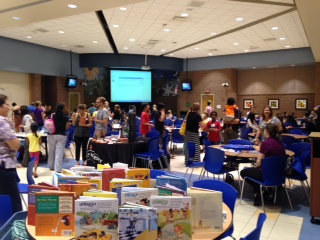 Hamilton Southeastern Schools serves the town (soon to be city) of Fishers, as well as many miles of surrounding countryside. To visitors, HSE might seem like the epitome the suburban middle America. Tonight’s event, however, provided much evidence to the contrary! ENL Night, or English as a New Language Night, is an annual open house specifically designed to welcome and provide resources for the international families in our learning community. The gathering brought teachers, administrators, and families together to share resources, answer questions, and build new friendships. Representatives from other local organizations were present as well–the public library, scouting groups, and more. As our student population continues to grow, HSE schools is committed to embracing cultural diversity and welcoming all newcomers. Currently, 64 home languages are represented among our students. We may be situated in middle America, but the potential for global awareness here is expanding every day.
 day I had been hoping one of my teachers would have THE chairs. No luck, until 7th period when I walked into calculus. There they were! The swivels! Now, fifteen days into the school year, I still look forward to the swivel. It’s not just that these chairs are so much more comfortable (which they are). It’s that I can pull the desk part as far forward as I want. I can sit front ways or sideways and still get the desk part in just the right position for whatever we are doing every day. I can always get into a good position to see our teacher. The swivel chairs help me pay attention, and when math is 7th period, I need all the help I can get. -11th grade student, FHS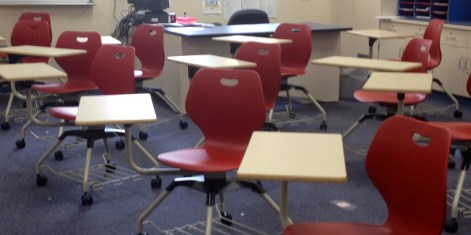

![photo 1[1]](https://hse21shorts.com/wp-content/uploads/2014/08/photo-11.jpg?w=300&h=224) An important 21st century skill is the ability to collaborate and share ideas among teams with similar goals. Fishers High School student government leaders did exactly that recently, when they traveled to the HCC Leadership Conference at Avon High school. For an entire day, student leaders from many Indianapolis-area locations connected on topics such as fundraising, community service, communication and school spirit. Each school’s student government shared experiences in these areas that other schools could adapt and use at home. Student-led discussions fostered brainstorming and the generation of new ideas and plans. Participants left with insight into student government AND into what it means to connect and collaborate with likeminded teams.
An important 21st century skill is the ability to collaborate and share ideas among teams with similar goals. Fishers High School student government leaders did exactly that recently, when they traveled to the HCC Leadership Conference at Avon High school. For an entire day, student leaders from many Indianapolis-area locations connected on topics such as fundraising, community service, communication and school spirit. Each school’s student government shared experiences in these areas that other schools could adapt and use at home. Student-led discussions fostered brainstorming and the generation of new ideas and plans. Participants left with insight into student government AND into what it means to connect and collaborate with likeminded teams. HSE21 Shorts